Showing posts with label scarves. Show all posts

Friday, October 30, 2009

What's That About? Snoods


Fashion's tastemakers, with blithe certitude,
Declared '09 to be the year of the Snood,
So you won't be caught napping
About this snuggly head wrapping
They mean a scarf you can wear like a hood.


Something about the word "snood" brings out the Dr. Suess in me. It's such a fun word to say. Go on. Snoooooooood.

Anyway, the tastemakers are inaccurate in calling a hoody scarf--or any sort of neckwrap--a snood, because this it ain't. The covering made trendy by Missoni (top) and others right on down to Gap is, properly speaking, a cowl.

Meanwhile, a snood, properly speaking, is some sort of ribbonlike or crocheted or cloth catchment for the hair, worn at the back of the head. Wiki tells us that the word comes from the Old English. In olde tymes in the northern regions of the British Isles, snoods were worn in ribbon form by women to indicate that they were unmarried.

Throughout their span of popularity, traditional snoods kept long hair tidily contained--either for social propriety or for professional safety. Here, a how-to posted by 16 Sparrows at the ever-informative Fedora Lounge. You have got to read this, it's hilarious.


Crocheting snoods became a popular pasttime in WWII, and patterns are easily found on eBay. I think they look especially great under hats, as a more formal alternative to a ponytail. And if anyone can tell me from which film this wonderful shot of Bette Davis originates, I'll write a bad poem in your honor.


(photo top of Missoni '09 show by AP, in the daily Telegraph; photo Bette Davis posted by Mean Jean on J-Walk Blog, thank you!)

Friday, March 13, 2009

Max Headroom


Every once in a while a photo shoot comes along that blows me away. Such is the case with Paul Wetherell's work for the current issue of Another Magazine. Styled with brilliant restraint by Mattias Karlsson, the model wears Gucci, McQueen, Sander and the rest of the best with lots of bare skin and a broad metallic cuff worn outside the sleeve, mid-upper-arm.

And one more thing: the hair. This is big hair. Pumped up, combed smooth and shellacked into queenly proportions, alternately reminiscent of geisha and Nefertiti. Completely and literally over the top, but it works thanks to the elegant cut and thrust of the garments. The headwear devised for the shoot is equally striking, as you can see . . .

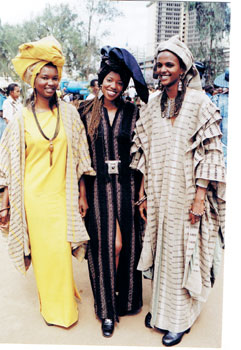
Does any of it translate into something you could carry off on the street? The swirled confection shown here nicks from the similarly massive head dresses customarily worn in Nigeria, but I venture few of us could get away with this kind of volume on the streets where we live. Probably true even with the more restrained versions offered up in Ralph Lauren's current ads . . .


If a turban isn't your thing, there's still a way to style your inner queen: wrap and knot a scarf around your head, then top with a wide-brimmed straw hat. It's a great summer look that isn't extreme, plus an excellent way to keep hair behaving at the beach.

Tuesday, December 23, 2008

Why a Scarf Costs £203/$375, Part One

Is it possible to justify paying this much for a silk scarf, even one from the most famous manufacturer in the world? The prices above are the going rates, taken from the Hermes websites in the UK and USA. What you get for your money is a 90 cm/36" square of heavyweight silk, screened with designs in multiple colorways. The designs are issued in a limited number, changing by the season.

All well and good, but heaps of scarves offered for sale are exactly the same size. Many use silk of similar quality. Their designs are equally beautiful (though perhaps not as varied in color, more on this in another post).

What else could justify the extravagant expense? Hermes itself vaunts its "hand-rolling", which means the edges of the silk are rolled under by hand, and then hand-sewn to create a plump edge.

The stitching is visibly irregular. It may seem odd that a process that builds in imperfection would be considered more desirable than the precision of machine sewing. Until you look at the corners of a scarf from Hermes (and other manufacturers that bother to hand-sew the hems). Since they are finished by a human, not a machine, the corners can be joined with exactitude--mitred, to use a term from furniture making.

The photo below illustrates the corners of two different scarves, both silk. The yellow one is Hermes, the brown an anonymous maker. In the Hermes scarf you can see the uneven stitching, but more importantly, a corner that approximates a 45 degree angle. In the other scarf, the edges only kind-of-sort of meet up.

So is this sort of handiwork worth that sort of money? That's a question only you can answer for yourself. But just so you know, eBay routinely offers up gorgeous and genuine hand-rolled scarves selling for less than half the cost in the headline above.