Tuesday, August 11, 2009

Anatomy of a Masterpiece IV: Balenciaga Pinned Down


I have the arch-insider fashion site The Fashion Spot to thank twice over today. Not only did their forum lend a definitive ID of the suit at left; it also provided a link to one of the suit's immediate descendants--a more figure-friendly variation that Neiman Marcus brought over to introduce Balenciaga to the wider American world. More about that in a bit.

The original, left, was photographed for Vogue in 1950, by Irving Penn. It is informally called 'the wishbone suit' due to the pattern of its buttons, which emphasizes its hourglass form. The model, Colette, herself had prominent hipbones and for this reason was said to be Balenciaga's favorite armature for his sculptural forms.

The suit appeared in Vogue again, this time photographed by Richard Avedon on what may have been his first assignment for the magazine, after he was talent-spotted by editor Carmel Snow. Here the model is Dovima. Snow's confidence was well placed--how beautifully the lines of the suit play against the weary net curtain behind. These fashions by Balenciaga and Dior and Chanel must have glided through the war-riven Paris streets like exotic fish through a wrecked ship.
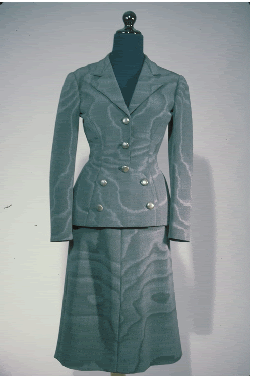


One final image, from the Texas Fashion Collection at the North Texas University Fashion Archives (via surgirl at photobucket via The Fashion Spot)--the wishbone suit in a new incarnation: in moire satin, with a wider skirt, bearing a Neiman Marcus label in addition to that of Balenciaga.

The department store was visionary in its pursuit of Paris couture in the 1950s, mounting a regular French Fashion Exhibition and contracting with the Parisian houses to send models over for elite clients. This fascinating history is meticulously detailed in Myra Walker's Balenciaga and His Legacy.

(I'm convinced that this gorgeous book brings as much pleasure as any garment possibly could: if you love fashion, get your hands on a copy as soon as possible.)

(Model with dog by Richard Avedon, for Vogue, November 1950 © 1950 The Richard Avedon Foundation)

Monday, August 10, 2009

Why Can't I Leave a Comment? Plus other housekeeping issues . . .

The quick answer is, I don't know. Even I always have to click the "leave comment" button twice--the first try never takes. So! If you want to leave a comment, just try a second time, and it ought to appear.

To encourage you, I'm posting this new ad from British heritage brand Aquascutum. They're trying to break away from their traditional buyership of dotty older ladies who will wear the same sturdy mac for forty years. How are they doing with this image, do you reckon?


Also! If you like the blog, please consider becoming a follower--anonymous is fine. It's encouraging!

And a very happy Monday to you.

Sunday, August 9, 2009

Her Suit


Dolce & Gabbana have decided that Huge Hairy Shoulders are the way forward for their Autumn 09 line . . .

Meanwhile, Chewie wants a credit, stat . . .

Friday, August 7, 2009

Now That's A Frock: Pierre Cardin


I am SUCH a fan of the early 1960s Pierre Cardin . . . in the early days, before the brand became hopelessly diluted by licensing deals, he designed dresses as sleek as racecars.

Here's a wonderful example, from So Vintage Patterns. Put a single pocket offline on a sacky sheath dress? He makes it work. Turn something like this out at home? Just awesome.

Thursday, August 6, 2009

Anatomy of a Masterpiece III: The Headdress


For master couturier Cristóbal Balenciaga, the hat was just that. His adornments for the head were as meticulously conceived and executed as the wraps around the rest of the body. Each of his hats, assembled on the premises of his atelier by Mme Janine or Hélène, was designed to complement a specific outfit, so that the entirety of the look became a mobile sculpture.

Among his most dramatic hats was this wingspan creation of 1948. (John Galliano liked it so much he paid homage in Dior's Fall 2009 Couture line.)


Less dramatic, indeed rather introspective, is the velvet beret Balenciaga used to top off the suit below, from 1950. Perhaps he felt its soft folds and rather frivolous tassel provided a necessary antidote to the strict lines of the suit underneath.


It's possible, too, that his own self-image as an artist of cloth was coming to the fore--this style of beret is less akin to those worn by Balenciaga's Basque countrymen as that worn by another quiet genius, Rembrandt, in numerous self-portraits painted in his chilly northern studio.


(photograph top: Clifford Coffin for American Vogue, 1 April 1948. Photo of Dior Couture Autumn 2009 by Monica Feuidi/Gorunway.com/Style.com. Balenciaga suit photograph: photographer unknown, for Vogue, 1950. Rembrandt self-portrait 1634, Galleria degli Uffizi, Florence)

Wednesday, August 5, 2009

Anatomy of a Masterpiece II: The World on his Shoulders


How lucky was the woman who saw this face, in this degree of concentration, for Cristóbal Balenciaga would not allow a client to leave his atelier until her gown, day dress or suit had reached his standard of perfection.

"Balenciaga was renowned in the trade for inspecting and resetting sleeves that were not perfect--even after the garment had been shown in a collection or was being worn by a client. He acquired these exacting standards during his training as a tailor in San Sebastian; travel guides of this period state appreciation for the skill of Spanish tailors--and the cheapness of their products in comparison with those of the French. (Lesley Ellis Miller, writing in The Golden Age of Couture).

Balenciaga's designs, like the suit at left, were far from cheap. This model from 1950 would have cost around 110,000 francs (a mind-boggling $35,000 at that year's exchange rate). What that bought in practical terms was a suit that fit a finger's breadth from the body, which afforded an immaculate line that did not constrain movement. In aesthetic terms it afforded, says Miller, less fashion than "a sense of eternity, of the reconciliation of past and present".

As a Balenciaga original is beyond the wildest dreams of most of us, what we can do is strive to take away from this master the notion of fit and how it ought to work.

Specifically, the fit of a garment at the shoulders, and from thence down the arm. I think it's safe to say that when fashion amateurs shop, they concentrate on how a garment sits at the three points of traditional measure (bust, waist, hips). If those conform in an approximate way, the garment is deemed "to fit."

Fashion professionals (and for these purposes I include in this group anybody who loves clothing enough to explore its making and history) know that fit begins at the shoulder. If a dress, jacket, or shirt doesn't sit right there, it may look just fine, but it will never be elegant, chic, soignée--all those words that define Parisian ladies looking amazing, seemingly without effort. Their secret? Their clothes fit their shoulders.


In these trendily padded days when Balmain and the like are sending scare-the-crows upper arms down the runway, shoulder fit can so easily go to hell in a handbasket--especially if one buys a knockoff. Be vigilant, even as you work a trend. Fabric should drop cleanly down from a shoulder, no matter how padded it is. No bunching, no wrinkled and sorry jowls below the set-in seam, no pinching around the underarm. Have another look at the eternally fashionable suit above. A shoulder should fit like that.

Tuesday, August 4, 2009

Lactotechnics


Lady Gaga, I applaud you, this is quite a feat of showmanship, not to mention mechanical engineering.

If one of those nozzles had packed up it could have gone so badly wrong.

I feel a certain professional duty to take this look and run down its vintage predecessors. In reverse order:

The Fembots in the Austin Powers films, whose bullet nighties were first inspired by . . .

Ursula Andress in The 10th Victim, who likewise shot straight from the tits . . .


And the mother of all spark-throwers, the Greek goddess Hera, who discharged no less than the Milky Way (with an assist from baby Hercules).

(painting by Tintoretto, The National Gallery, London)